How one writer’s son
stopped Doctor Who’s first four episodes appearing on the iPlayer

How one writer’s son
stopped Doctor Who’s first four episodes appearing on the iPlayer
A triumph that still hums with energy! Looking back at one of classic Doctor Who’s best ever stories.
Earlier this year I saw
the World of Wonder exhibition and amongst the many exhibits from the series’
past and present were some robot masks from this 1977 classic. Even now, mounted on stands devoid of the
rest of the costume, they look impressive. So it is for the story they come
from. Its one of those tales that they could remake today without the need for
much alteration, Sure the Sandminer -which in real life was quite a modest
sized model – could look better, you could have more robots, a larger crew. Yet
the essence of the story works just as well forty-five years later.
There is something stately and unhurried about ‘The
Robots of Death' that makes it a joy to watch every time. On paper the story is
hardly original, purloining much of its content from the likes of either Murder on the Orient Express or Isaac
Asimov's Robot stories, while the use of mostly brightly lit sets and a robotic
enemy realised by people in costumes and masks could have been a disaster. Yet the
story towers over these potential problems with ease to create a timeless 90
minutes that is amongst the very finest Doctor Who ever made.

In the final look back at some of the early years of the DWAS publication Celestial Toyroom we alight at 1978. In Gallifeyan tradition we've been travelling largely backwards in time from the early 80s and before 78 CT was more or less just a Swaps and Pen Pal zine so not really of significant interest even then. Unless of course you wanted to offer rare items for a genuine Chumbly bathmat or something. In 1978 however it became a monthly newsletter though back then news was much thinner on the ground than you might expect. In fact the front page was not current news at all but imagined headlines each relating to a particular Doctor Who story. Most of the news was included inside Jan Vincent Rudzki's Presidents Column while the rest to the issue comprised press cutting, announcements and, yes, still the swaps and pen pals which in fact went on for many years. So, here's some scans of some of the issues to give a flavour of what they were like. It may seem inconsequential now but back then we used to get quite excited by the arrival of each issue if only to try and guess what colour paper it might be printed on!

October
That rumour of a Marvel Doctor Who publication
becomes fact this issue with the news of the new Doctor Who Weekly which for
12p (cheaper than most fanzines!) will give you a professionally produced Doctor
Who fix every seven days. The editor Dez Skinn is adamant it is not a comic
but a magazine including a comic strip. Meanwhile, two of the three Convention
organisers are now leaving meaning that there is no one to organise next years.
In his column JVR talks about the event highlighting a move away from just
guests to showing visual material. “The best part for me,” he writes, “was the
incredible atmosphere during the showing of the old episodes.” He mentions
guests not wanting to repeat themselves by attending every year though he
chooses to mention Jon Pertwee who was of course something of serial repeater
of anecdotes! At the end of his column outlining the latest Ref Dept releases,
J Jeremy Bentham thanks people for their ideas and signs off by adding “part of
that future could depend on reaction to Doctor Who Weekly`…” Watch this space...

July
`Invasion` is the headline of July’s issue which in time
lag fashion reports on the 1979 Blackpool gathering which took place in May on
Cup Final Day in Blackpool. More than 40 members from around the country
converged on the resort and its Exhibition for a social weekend organised by J
Jeremy Bentham. Meanwhile Panopticon 3
is round the corner and tentative guests include Dick Mills, Graham Williams
and Douglas Adams. Attendees will get to see Oceans In the Sky, the
evocatively titled DWAS drama department film. This ambitious project is
reported here to have taken three years to make at a production cost of £3,000
(which is something like £12,000 today).
Sets built include a Tardis console and it has a score written by Mark
Ayers in his youth. Twenty actors appear in it and the Doctor is played by Leo
Adams and the companion by Diane Woodley.

April
`Monsters` declares the lead story in the rather thin April
issue declaring “the prolonged absence of monsters from Doctor Who will
soon come to an end.” This comes from the mouth of new script editor Douglas
Adams who is quoted as saying “I think we’ve shied away from the monsters for
long enough so I hope to bring them back.” This story suggests that Adams
approached the script editor job with considerable energy at first. Meanwhile
its revealed that the first story of the season will be titled `Destiny of the
Daleks`. John Leeson’s departure from voicing K9 is also confirmed though the
rumour is a new actor will be taking on the tin dog’s distinctive vocals next
year. It is also time once again to vote in the Season Poll with Season 16’s
stories comprising the Key to Time Season up for you votes. Last year’s winner
was `Invasion of Time`.
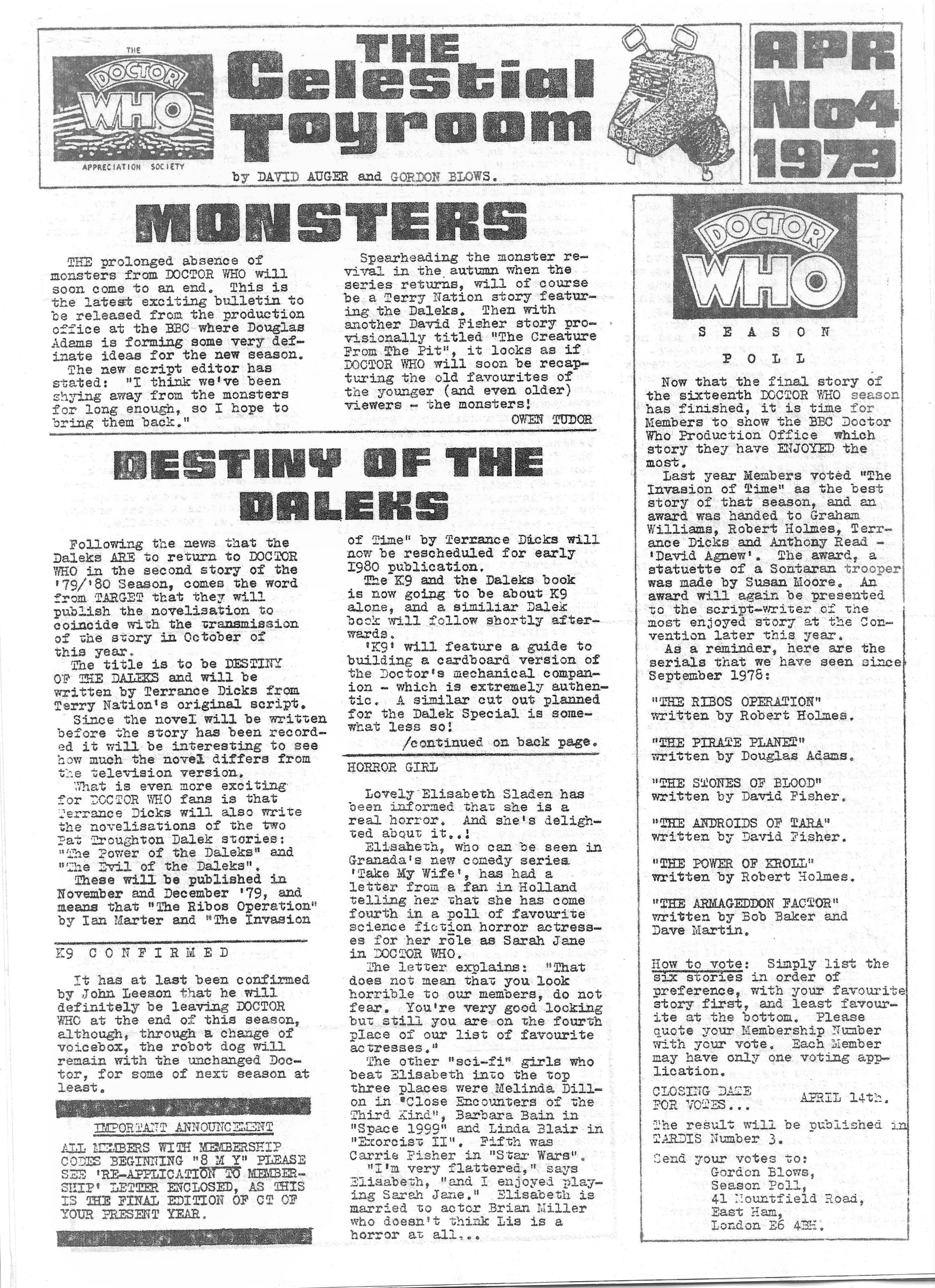
The world of Doctor Who
as it was reported in the Doctor Who Appreciation Society newsletter Celestial
Toyroom aka CT.
January
As 1979 dawned the DWAS
newsletter was being co-edited by David Auger and Gordon Blows and had an
amateur yet well- constructed quality that gave it, appropriately enough, a
news paper look. `Tony Read Quits` was the main headline in January’s edition. Anthony
Read, as he was officially known is, according to the article credited with
instating a policy that the Tardis is fully controllable. Arguably the more
important news is that his replacement will be Douglas Adams who is described
simply as “the author of this year’s Pirate Planet` showing that Hitch
Hiker’s Guide to the Galaxy had yet to become very widely known. `Disco Dr
A Hit` CT also reports referring to the latest version of the title theme by a
group called Mankind. Apparently it’s selling a thousand copies a day taking it
from number 67 to number 45 in the singles charts and was featured on Top of
the Pops. Bear in mind that there is a six week or so lag between things
actually happening and being reported in CT so we learn that while there wasn’t
time to organise a Xmas party this year people can meet in the One Tun pub on
21 December. Of course being Doctor Who fans they can just travel back
in time a month! There’s an Obituary for Brian Hayles who died recently after
completing The Moon Stallion.

I remember when a continuity announcer
said that the next story would be called `The Sea Devils` and I had no idea if
this was some sort of monster or period pirate piece. Since then I’ve always
loved `The Sea Devils` and now I can't quite believe its fifty years since I
first saw it. Inevitably it can’t thrill me like it did as a child but yet it
still has a magic. Many parts of it fizz with energy and even if from this
distance it can look ramshackle at times the overall effect is still strong.
Part of the reason why its endured is the very experimental incidental music by
Malcolm Clarke and the design of the Sea Devils themselves. Even if their eyes
don’t move! So forgive if this is less a review and more notes.

It is forty years since Doctor Who fans got two big shocks with `Earthshock`. I was lucky enough not to know what was coming up in this story so I was able to be shocked indeed. Anyone who watched the episode live back then will tell you what a big impact it had- the latest DWM has some examples- and all this time later it remains one of those stories that you watch with anticipation. The edge is still there- this is not a cosy watch like for example `Revenge of the Cybermen`, it’s a thriller with bite. It wasn’t just fans who were affected by `Earthshock`. It proved to be a hugely influential story on this period of the series which turned out to be a good and a bad thing. On the positive side it’s style led to a number of subsequent stories pushing the envelope when it came to both scripts and presentation such as `Caves of Androzani,` `Revelation of the Daleks` and `Vengeance on Varos`. However it also started a trend for a more violent streak in the show which ultimately was a contributing factor to the 1985 hiatus.

Peladon is as rich a planet as was ever
created for Doctor Who. Its murky passageways lit by flickering torches
seem so far from the studio environment in which they were constructed. Its
almost as if the stories were filmed on location on Peladon itself! Its pagan
tradition seems rooted down the centuries rather than scribbled out at a script
meeting the other week. Perhaps because the series at that time was mostly set
on present day Earth, those stories which are not resonate particularly
strongly. One of the best aspects of the two Peladon stories is a strong sense
of time and place. A feeling- still rare in the series to this day- that these
people were here long before the Doctor and will still have lives afterwards.
Moreover, writer Brian Hayles invents an entire history, structure and society
not just for the planet Peladon but the Galactic Federation as well. It is
quite intricate in detail and sounds convincingly believable as well

In 2011 Doctor Who fandom
was divided about the merits of the Special Edition of `Day of the Daleks` but
I loved it and over a decade later I still do. Fact is I actually-gasp- prefer
it to the original. This is only because it really is the
original as the production team and viewers would love to have seen it. I
suspect many viewers actually think this is what they saw! The story
hasn't been changed in any way simply enhanced visually to better support the
narrative. Plus if you don't like it, the original transmitted version is still around of course. This story was an event and a half in 1972. The Daleks
back for their first story in seven years, heralded by a stunning Radio Times
cover from the pen of Frank Bellamy. Alongside the comic strip cover for the
1971 season the previous year it remains one of the best RT covers ever.

“I am usually referred to as The Master”. With just eight words a new classic tv villain made his debut appearance fifty years ago yet nobody could know just how defining a performance Roger Delgado would give and how enduring the character would become. The Master has re-appeared in many guises over the subsequent half century yet the benchmarks are all laid out from the start. Generously afforded the role of (increasingly un-surprising) enemy in each of 1971’s stories enabled both character and actor to develop a popularity to rival that of the Doctor. Yet there was nothing complicated about The Master really. Clad in black and sporting a Mephistophelian trimmed beard the only way he could look more evil would be to sprout a couple of horns. In another actor’s hands it could have been unimpressive but gifted a role he was totally suited to Roger Delgado makes it his own, so much so that every Master since has used it as a template either to copy or develop. As an example of how in thrall the Eighties version of Doctor Who was to its past when they recast the part they made the actor look as similar as possible to Delgado. Nowadays writers like to pry into the psyche of the main characters but this version of the series never went too deep. They didn’t need to. The Doctor versus The Master is clear good versus evil and kids at that time were happy with such escapist adventure.

Growing up in the Seventies we only got
to see each episode of Doctor Who once (or maybe twice if it was repeated)
so the Target novelisations were our equivalent of how you can now watch any existing
episode whenever you want. Crucial to those books were the covers especially the
earlier ones which were the work of Chris Achilleos who sadly died this week.
His artwork created a heightened, stylised version of Doctor Who with a
grander and more exciting visual aesthetic than the reality of the series. Yet he
was also able to home in on the elements that made each story tick. Finding a
new book and a new cover was like discovering new treasure and those covers
somehow became synonymous with the stories they depicted.

October
“The latest Doctor Who news supplied by the
production office and society members” it says under an Update headline. I
wonder if there was some issue with news in CT or perhaps the notoriously
finnicky JNT just wanted credit. Anyway, the subsequent story does have a whiff
of press release about it with the plucked from thin air suggestion that the
new season “looks like being the biggest success for some time”. “The
brilliant, imaginative Leisure Hive,” it continues and later on we’re told “we
are being treated to one of Emrys James’ performances.” Why you can almost hear
John Nathan Turner’s voice! Romana is going – “but K9 will go on.” You can buy the theme music too with a b side
called `Astronauts` though it’ll never match the legendary b side `Reg`. Chris Dunk rather cheekily prints a picture
of a press review of `Leisure Hive` underneath all this sunny promotional
banter and its not a favourable one referring to “very cheap
camera effects” and concluding “no-one seems to have any faith in this geriatric
juvenilia”. Hardly “brilliant, imaginative.” Other news includes a Madame
Tussaud’s display and a Doctor Who war game called `The Key of Kronos`
in which players take on the character of one of the Doctors to search for a
key that is in six segments. Sounds familiar. It doesn’t say if they have to dangle
from the ceiling dressed as Kronos though.

July
`Decay in Studio` is the headline this month though rather
than a story of dry rot it’s actually referring to the news that the unmade
story formerly known as `The Vampire Mutations` or `The Witch Lords` and more
recently dubbed `The Wasting` is now to be titled `State of Decay` and
broadcast fourth in the new season. The news item reminds us that this Terrance
Dicks tale was originally penned three years back but pulled due to the series
being instructed not to `send up` a lavish BBC2 version of Dracula. At
the time this raised hopes that `Shada` might also be resurrected but it was
not to be. The issue also reveals the title of the second story as `The Last
Zolphathoron` and that Jacqueline Hill is returning to the series. Of course we
all thought this meant Barbara was going to appear.

